Wednesday, 11 May 2011

The historical Lenggong region

Today, the road from Kuala Kangsar to Gerik is a modern 4-lane highway.  This has delighted a lot of frequent travellers along that part of the country.  However, the highway has by-passed several towns and villages which were once important ports of call from the weary travellers. But, somehow, these towns have survived and some people still stop at towns like Ayer Kala, Lenggong and Sauk for their breakfast, lunch or dinner before continuing their journey.  Although these towns are off the highway, people are still willing to turn into the old road to these place to taste their famous freshwater delicacies.


At the main road in Lenggong town is this famous restaurant which sells the famous Lenggong fish-balls.  These fish-balls are made from fish caught from the nearby river and lakes and are more springy or bouncy than those sold at other places.    


On the main road too, is the Lenggong post office.  It is still located in the same old building which was built years ago.  In most other places, post office like this would have been replaced by some ugly modern one.  This post office has a character of its own.


Not too far from the Post Office are two more restaurants which sell the famous Lenggong fish-balls and also a whole variety of fresh water fish dishes.  On certain days, even fresh water frogs are available.  It must be said that all three restaurants are good but each has its own style of preparing the dishes.  So it is up to the individual to give the verdict as to which is actually the "best".  Whatever fish you order, please remember to ask about the price first because some variety of fresh water fish can be quite expensive.

THE LENGGONG MUSEUM OF ARCHEOLOGY


This signpost is placed at the junction of the main road and the smaller road leading to the museum.  It is just a few kilometers from Lenggong town.


The entrance to the museum is rather unique and is made to look like cave.  Admission the museum is free.


The museum is proud to house the story of how the remains of the Perak Man was found and the discovery of the existence of a very early civilization.  There are a lot of displays like the ones above and also ancient artifacts from archeological work done in the area. 


This is a urinal pot  - for people of the olden times who are just too lazy to go to the toilet at night.  It is part of the exhibits displayed at the maritime exhibition section. 


The museum has outdoor exhibits too.  Here rocks and their characteristics and time of their formation are being displayed.  It will give the geography teachers great happiness to bring their students here for a better understanding of rock formation.

LATA KEKABU


Nearby is a popular picnic spot by a beautiful waterfall - named Lata Kekabu.  On weekends, the crowd will be there.  This place is well kept and the surrounding is peaceful.  However the road leading to this waterfall is quite narrow and one should drive slowly and carefully.


This is the entrance to the waterfall and there is ample parking space for cars. This place is very spacious and there is a lot of room for people to sit under the shade of trees.  There are changing rooms too so one need not hide behind bushes to change clothes.    


As we enter the place, we can see a wooden foot bridge across the steam of clean and clear water.  There will be a signboard after the bridge to show directions.  Just follow the directions and you will come to a "hanging bridge" where you can go on to see the waterfall.  Do be careful because some of the other bridges further up are not in very good condition and are in need of repair. 

TASIK RABAN RESORT

On the way back to Kuala Kangsar, we stopped at the Tasik Raban Resort.  This place is located at the lake side and has numerous chalets for rent.  It is a haven for anglers because the lake is full of freshwater fish.


Here we see a row of chalets which are suitable for small families and they all provide a good view of the lake.  The rental rates are reasonable too.   It is managed by the Lenggong District Council which can be contacted through 05-7512799 or through its website - www.mdlg.gov.my


This is the resort restaurant and it is located on the opposite side of the lake.  It serves some good freshwater dishes and will also cook fish caught by its guests.


To move around the area, one could rent these bicycles.  It will provide you with good exercise because the air at the countryside is fresh and clean.  It also gives you a chance to have a closer look at the countryside, which you may not be able to do if you were to drive a car.    

  This is the gateway to welcome you to Tasik Raban Resort, in Lenggong.  If you plan to have a quite and relaxing holiday, then give this place a try.

KAMPUNG BARU SAUK

For lunch, we stopped at Kampung Baru Sauk, a few kilometers away from Lenggong towards Kuala Kangsar.  This small village is famous for its river fish dishes. On weekdays, at lunch time, this place looks rather quiet but at night, especially on weekends, the place is so crowded that one may have to wait for some time to get an empty table.


                                                This is the gateway leading to Kg. Baru Sauk.

 There is a lonely barber shop across the road -it looks airy and even has a bench outside for customers to sit and wait for their turn.  Surely this is a good sign that this barber enjoys good business from the villagers.  

                                       Another view of the arch that leads to Kampung Baru Sauk.

  Just beside the gateway or the arch,on the right, is the famous river fish restaurant, you just can't miss it.   It is opened for lunch and dinner.  There will definitely be a large crowd of people on public holidays.

Sunday, 24 April 2011

An Old Jetty at Taping Lake Gardens

Taiping is famous for its beautiful lake gardens. As one approaches the lake gardens from town, along Jalan Maharajalela, one will come to a T-junction and the old jetty is located right at the T. From what I have gathered from the locals, this jetty is called the Coronation Jetty.  Whose coronation? I am not very sure about that.  But I know that it has been there for a long time and is no longer functioning as a jetty.  It has become a resting place for tired joggers and also an ideal place for people who fish at the lake.


The old jetty was given a new coat of paint by a group of international young people who came to visit Taiping last year.  They have done a great job in removing all the moss and fungi, and giving it a new coat of white paint which has brought back its original beauty.  


Seen from this angle, we can see that there are steps from the jetty leading down to the waters of the lake.  Perhaps, during the "coronation" celebration - the jetty was built to enable some very important personality to get on a boat on the lake.      


At the base of the jetty, there is a sign which is still visible, stating the name of the contractor and the year in which it was constructed.  The contractor was a Mr Neelatamby and the jetty was constructed in 1936. 


Today, there are fun boats for visitors to ride on the lake and a new jetty has been built.  However, the old jetty remains where it is and let's hope that this unique structure will be preserved and not destroyed to give way to "development".

Tuesday, 12 April 2011

The End of the Line

As we rushed through "modernization", many aspects of our society have been left behind to die a natural death.  One such traditional institution that has become a victim of modernization is the old railway line and everything related to it.   Railway stations that have been built more than a century ago, can no longer serve the needs of the modern times.   Many of them were left idle, to die a natural death.  Others were not so lucky - they were demolished and new ones have been built in their place.  Yet, there are others which have disappeared without a trace.


This one above was the first to be built and the first to go.    It was the first railway station built in Malaysia for the line which linked Taiping to Port Weld.  The line was used mainly to transport the valuable tin-ore from the Larut tin mines to Port Weld where they were shipped away.  As the port lost its importance, so did the line. And today, all that remains is this board.  The station is gone and so is the line.  Even the town has its name changed to Kuala Sepetang.   Fortunately, some wise folks have decided to keep this board from the old railway station as something the future generation can feel proud of about their humble town.


This railway station too is just waiting for its time to go.  Even the signboards - the ones in white - as seen in this picture, were constructed more than a century ago and is still standing, will be replaced soon by "modern" ones in blue.  At present, the signboards at Kuala Kangsar and Taiping railway stations are already gone. 

LEVEL CROSSINGS

Along the west coast of Peninsular Malaysia, we are now seeing the disappearance of the old time level crossings, where gates were closed to road traffic when the train is crossing the road.  Today, gradually most of these gates or level crossings have been replaced by fly-overs.  Of course, it is more efficient this way and it also reduces the chances of accidents due to human error at these crossings. We cannot but feel a sense of loss when these level crossings are all gone.  The only ones that can still be found are along the railway line that runs along the east coast.  Along the west coast, only a few remained and these too have their days numbered.

This level crossing is at Gunung Semanggol, along the line from Taiping to Butterworth, going across the road from Kamunting to Gunung Semanggol.  This road will be closed when the fly-over is ready.  


This is the same level crossing as the above, but as you can see, construction of a fly-over is in progress.  In fact, by the time this picture is published in this blog, the level crossing no longer exists.  The fly-over has been built, this road is now closed to all traffic and the level crossing was demolished.


This level crossing is more fortunate because it will not be replaced by a fly-over so soon.. It is located at Sungai Petani, Kedah, and the construction of the double track railway will not reach there so soon.  The focus of the construction activities, at present, is centred along the the Ipoh - Butterworth line.  

FALIM RAILWAY DEPOT


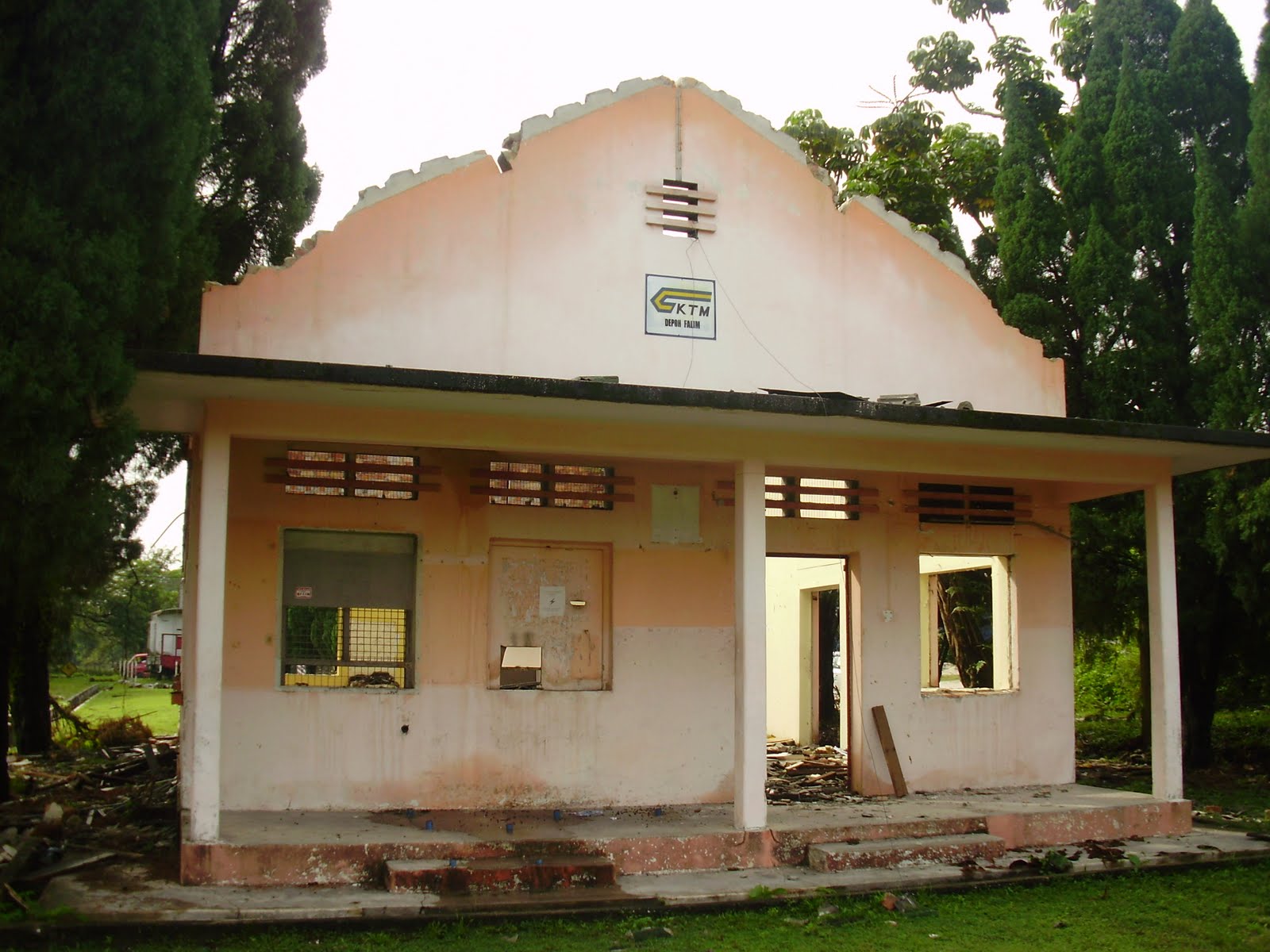
This is the remains of the railway depot station at Falim, near Ipoh.  The place has  been razed to the ground and there is no sign of the depot except this building and a display railway wagon by its side. 


This piece of display wagon still stands on the depot ground.  I think it is a wagon that was used to carry important cargo, perhaps cash, because of its solid steal walls and doors.


There is no sign-board to tell us anything about this wagon.  On closer look, we could see that this wagon was made to the Indian Railway Standard in 1944.


Tuesday, 5 April 2011

Fryer Road Ipoh

Fryer Road is a very little known road which runs behind the Ipoh railway station.  Not many people use that road because it is rather narrow and doesn't seem to lead to anywhere significant in town.  Today, it has been renamed Persiaran Tun Perak.  Just to go down memory lane, I went along that road again this morning to see  if things are still the same.  I remember walking along this road whenever we wanted to go to Ipoh town and also to school when I was a boy.  So what did I find?  First, I felt rather disappointed because the railway quarters along this road are no longer there.  Next, I went looking for the turn-table - the place where they used to turn the old railway engines around because as we know, railway engines could not make a u-turn on the railway lines.  That too was gone.  But fortunately, after going down the road a bit further, I came across some familiar sights.


The Hindu temple is still there!  It was just a small shrine during my childhood days and I can still remember hearing the sound of its bell every evening.  To many of us, when we heard the sound of the bell, it meant that it was time to stop playing and to go home.  Today, the shrine has bloomed into a beautiful temple and I am sure its bell still rings every evening.


The temple seems to be standing alone, looking so lonely, unlike in the past when it was surrounded by rows and rows of railway workers' quarters. We used to call those quarters Down Quarters because they were located in a valley below the level of the road.  Today, there is no sign of those quarters, they have all been demolished.      


I was surprised to see this sea-coconut tree next to the hindu temple.  This is a very old tree and is the only one of a few left in this area along Fryer Road.   There used to be so many of these trees in this place. The fruit is delicious with its jelly-like flesh.  


                    This is the name plate of the hindu temple with a lot of information in  great details.
          

Just next to the Hindu temple, is the prayer hall for the Sikhs.  It also survived the wind of change and remains where it used to be.  Of course, like the hindu temple, it has undergone some changes and has looked nice and beautiful too.   


Like the hindu temple, this sikh gurdwara also has a magnificent tree by its side to give shade. It is so good to know that such trees are not chopped down in the name of development.


A few meters down the road, is another Hindu shrine. This one is relatively new and was not there during my childhood days.  Nevertheless, I think a lot of art work has gone into erecting this shrine and it looks so peaceful too with those coconut trees all around it. The fact that there are so many places of worship located along this short stretch of road, reflects the rich cultural history of the people who stayed here in the past and the level of tolerance and harmony that existed at that place.


Then, I was delighted to know that our "tunnel" or the subway beneath the railway lines is still there.  This is the longest subway which pedestrians can use if they want to get from Fryer Road to the Ipoh Railway station.  There used to be short subways between platforms at this railway station, but they have all been filled up and closed up.  Overhead bridges have been built in their place.As you can see in the picture above, there is ample parking space and the entrance to the subway is just a simple structure with no signboard at all.  Those people who are unfamiliar with this place will not even know what it is if no one tells them about it.  Those days, the entrance used to house a small Hainanese canteen where the best coffee and toasted bread in town were sold. Anyway,  tt is good to know that although the Ipoh Railway station has undergone a lot of changes, many aspects of  its heritage has been preserved.


At the end of Fryer Road, there is a junction to Jalan Tun Perak.  This is another road which is rich in historical landmarks.  Very near to the junction is an old railway crossing.  The railway lines lead from Ipoh Railway Station to Falim station.  It was a line used for shunting purposes and there was also a railway workshop in Falim.  The railway line is now not used anymore, so it is slowly being overgrown with grass and weeds. 


The picture above shows the home of the gatekeeper and also a small concrete structure in the foreground which was where the signal lamps (oil lamps) were kept.  Both of these places are now not in use anymore.
 
As you can see in the picture above, these are the levers which the gatekeeper had to pull to allow the train to go on the right or left line when there is a fork at the railway lines. They are also used to control the signal lamps - red or green for the on-coming trains.  This was used before they were replaced with electric ones.    


As shown in the picture above, when the gatekeeper pulls the lever, the signal will fall from a horizontal position.  If it is night, then the signal will be lighted with an oil lamp behind it so that when it is in horizontal position, the red plate of the signal will be lighted up, but when it falls, the green filter will be lighted up. If you see carefully you could see a ladder going up the structure, this is for the gatekeeper to climb up at night to put the oil lamps behind the signals. In this picture, the signal on the left has fallen, so the train driver knows that the gate at the level crossing is opened for the train and closed to road users.   The younger generation will no longer see such signals along the railway tracks in the very near future because they have all been gradually replaced by electric lamps like those at road junctions.


At the base of these levers we can see the names of the manufacturer and the year in which it was made.
It was made in London in 1947 and was patented in 1921.  Until today, it still remains solid and could still be used despite the exposure to the sun and rain. 

Sunday, 3 April 2011

Ng Boo Bee Fountain in Taiping

     Ng Boo Bee may not be very well-known among the younger generation in Taiping but he was a prominent tin miner and a philanthropist who once built and owned half of Taiping town.  Today, all that is left in this man's name is a short road in the centre of the town named Jalan Boo Bee and a fountain in the Lake Gardens.  I strongly suggest that local students do a research / project on this man.  He was also said to be the de facto Finance Minister of Perak during the British administration. 

This is the Ng Boo Bee fountain located at the Lake Gardens in Taiping.  At a closer look, one notices that it is made of cast-iron. It has not been switched on for a long time and I am not sure if it still functions. I hope it does.  Once it was THE attraction at the garden and there were many wedding phototgraphs taken at this fountain.  Make a visit to any old photo studio in town and one would most likely to come across black and white wedding photos taken at this fountain.    


Monday, 28 March 2011

Shun Tak Association Taiping

The Shun Tak Association in Taiping is one of the many Chinese associations in town.  The more well-known ones are the Kwantung Association, Hokkien Association and Foo Chow Association.  These are large associations with large membership.  The Shun Tak Association is one of the smaller associations with a present membership of around 60 only.  This inevitably means that the association do not have much fund.  The association is an active one and has numerous activities throughout the year for its members but the main problem lies with the maintenance of its heritage building.  To renovate the building back into good condition needs more than a million ringgit.  That is an amount that the association do not have.  So, instead of leaving the building to rot, the association has let it out to a banner printing company to get some income to do repairs and maintenance.  It is a pity, because the beauty of the building is totally "lost" under the cover of banners and advertisements.  It must be mentioned that this is the only Shun Tak Association in the whole country with such a beautiful building. All the other Shun Tak Associations - in Ipoh, KL and even Penang -  are housed in modern shop lots. Because of its small membership, the heritage building is simply too big to handle, so at present, the Taiping association too has moved into another of its property in a modern shop house.


This is what the Shun Tak Association building in Taiping looked like a few decades ago.  It housed the association and its main income at that time was from rental of tables for mahjong players. 


 This is what it looks like today.   The sign board is still there but the mural above it has faded. 


Today, the entrance is no longer visible and it is being covered with the name of the advertising company that rents the place. 

Cracks start to appear all over its wall and a lot of money is needed, if a renovation program is to be undertaken.
In the meanwhile, with the heritage building being rented out, the association is now housed on the first floor of this shophouse building.

  The ground floor is rented out to a law firm and the top floor is also rented out to a resident.  It is hoped that the old heritage building will catch the attention of the authority or organisations which has interest in renovating it to its original glory and make it into a tourist attraction.  The Shun Tak Association Taiping committee is looking forward to lease it out to someone who has this in mind.  With proper planning and care, I am sure this is a good investment for anyone with the money to spare.  Examples of how heritage buildings are turned into successful tourist attractions can be found in Penang and Malacca.  So, why not in Taiping too?