Monday, 18 November 2013

Backstreet Art in Ipoh

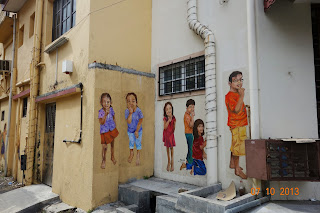
Penang is already well-known for its street art or wall graffiti by Ernest Zachervic.   Some are painted on worn-out walls while others are created out of iron bars within its Heritage Enclave . Recently, Johor Baru too, hit the headlines for its controversial wall graffiti. However, a bit less well-known to many, is that Ipoh too has its share of street art and came up with its own version.  However, the street art of Ipoh is only found on the walls along a back lane, between Hugh Low Street (Jalan Sultan Iskandar) and Hume Street (Jalan Masjid Panglima).  It seems these are the work of an art teacher, Eric Lai and his students.  Generally, they are centred around the theme of games children used to play and other common local economic activities which were carried out in the past.


This a drawing of a rice farmer riding a water-buffalo, which was a very common sight in the rural areas a few decades ago.  Today, not many farmers use buffaloes.  Tractors and modern machines have replaced them

 
This is a picture of a lady rice farmer carrying a sickle.  Again, this was very common in the past, but now harvesting is mostly done by machines.

 
A fisherman landing his bountiful catch.

 
Young men and their lion dance.

 
Another favourite hobby of young people in the past - keeping fighting .  There used to be a lot of fighting fish in the padi fields and the nearby ponds.  My cousin, Ah Chai, used to claim that the best fighting fish are those from the rice fields of Thailand.  They are the best fighters.  These fish just can't stand the sight of another of its kind.  The moment one is put into a jam jar with another, both will change into dark colour and fins, gill covers expanded. Watching these fish fight could be quite a experience for the uninitiated. Almost immediately, they really tear at each other, usually leaving the loser dead.  Do children of today still challenge each other to a fighting fish fight?  I don't know. I have not seen any children carrying fighting fish in plastic bags or jam jars around to visit friends anymore. 

 
Then, we have a Malay cultural activity here - kuda kepang.  This is a kind of hobby horse performance that is a popular form of dance in Johor.

 
A zoomed-out view of the back lane.  Notice the emptiness - unlike in the past, now there is no children running around, playing games and shouting at the top of their voices.  In the past, for most of the children in towns, the back lanes were their playground.   .   

 
An Indian classical dancer is depicted here.

 
Children playing hide-and-seek.  This was something we used to see at back-lanes, but not anymore. 

 
The children telling the viewer not to reveal where they are. 

 
Ah! So that boy on the left is supposed to seek the others.

 
Boys won't let the girl join them

 
Another common economic activity in the past.  Mining for tin ore.  Panning or dulang washing, as it is called, locally.

 
This looks like another old favourite game of chicken and the fox.  The mother hen is supposed to protect the chicks from the fox. 

 
Blowing soap bubbles using bottle-cap openers.


And, on sunny days - children used to cycle to the nearest stream or waterfall for a swim.  Their bicycles are on the left.


From the drawings I  get the general impression that the artist is trying to preserve memories of his childhood days on the walls of this memory lane.  Maybe he used to stay there. Anyway, it is a job well done, indeed. Let's hope he and his students will continue to add more pictures like these to the existing ones.   Like they say, every picture has a story to tell.  I'm sure, for every one who was a child in the 1950's - 1970's era, can identify with these drawings and will have their own story to tell to their children and grandchildren who otherwise may find these drawings quite meaningless. 


Friday, 15 November 2013

Bits of Bukit Mertajam in Taiping

This is the process of the unstoppable "progress" that a society has to undergo.  Sometimes bits and pieces of a particular community will undergo changes and disappear from the memory of its residents. That's part and parcel of progress and it is inevitable.  But fortunately, there are people around who like to  "preserve" some of these bits and pieces from disappearing altogether. So,  I was pleasantly surprised when I stumbled upon bits and pieces of the old Bukit Mertajam railway station in Taiping town.  The old railway station at Bukit Mertajam has been torn down and has been replaced by a 'modern' one.   This is something which is happening to all the old railway stations on the west coast of this country  They have to make way for a modern double-track railway system. And, they are all being razed down and are being replaced by  modern ones, except for two - one in Batu Gajah, and another in Taiping.   I have often wondered what happened to the "remains" old these old landmarks?   Well, I discovered that the First Gallery in Taiping does have an interest in preserving such 'relics'.  So, they have brought bits and pieces of Bukit Mertajam old railway to their backyard.   I don't know if these bits and pieces will be re-assembled or not, but they are left there - safe from total extinction, at least for the time being.  The First Gallery in Taiping must be congratulated for acquiring these bits and pieces, which I am sure, are not wanted by Bukit Mertajam's folks.  Whether they are a gift or whether they were purchased as scraps, the First Gallery people must be commended.   They have preserved a piece of the past, which can no longer be seen elsewhere, for the future generations to see and appreciate.    


This is a part of the overhead bridge for passengers to cross the railway lines from one platform to another

 
The signboard that used to be at the old railway station


The overhead bridge 

 
 The interior of the overhead bridge.  The timber is still in good condition.


Will it be re-assembled?   Hopefully, so.


Once re-assembled, it may lead visitors from one part of the First Gallery to another. 

Thursday, 30 August 2012

Memory Lane Ipoh

Just took a walk down Memory Lane (Horley St.) Ipoh to look at the crowd and some of the nostalgic items put on sales.  It is the place where one can find almost any old items which are no longer available at the normal outlets.  Even parts of an item can be bought here, especially for those who are good at restoring old broken down items.  Walking down this Memory Lane can take hours and you just don't feel time passing by because you are sure to be fascinated by some of the items there and you can take as much time as possible to touch, see and examine them, as you like.  Some people call it a flea market, while others call it a thief market and yet there are the more humble ones who name it the second-hand market.  But, officially, it is aptly called the Memory Lane.


  This is the gateway to Memory Lane.  The canopies are mostly stalls selling new items such as clothes, shoes and handbags.


This man is selling old gas lamp, charcoal iron, old record player and a whole collection of items from the past.  Most of the items still work! 


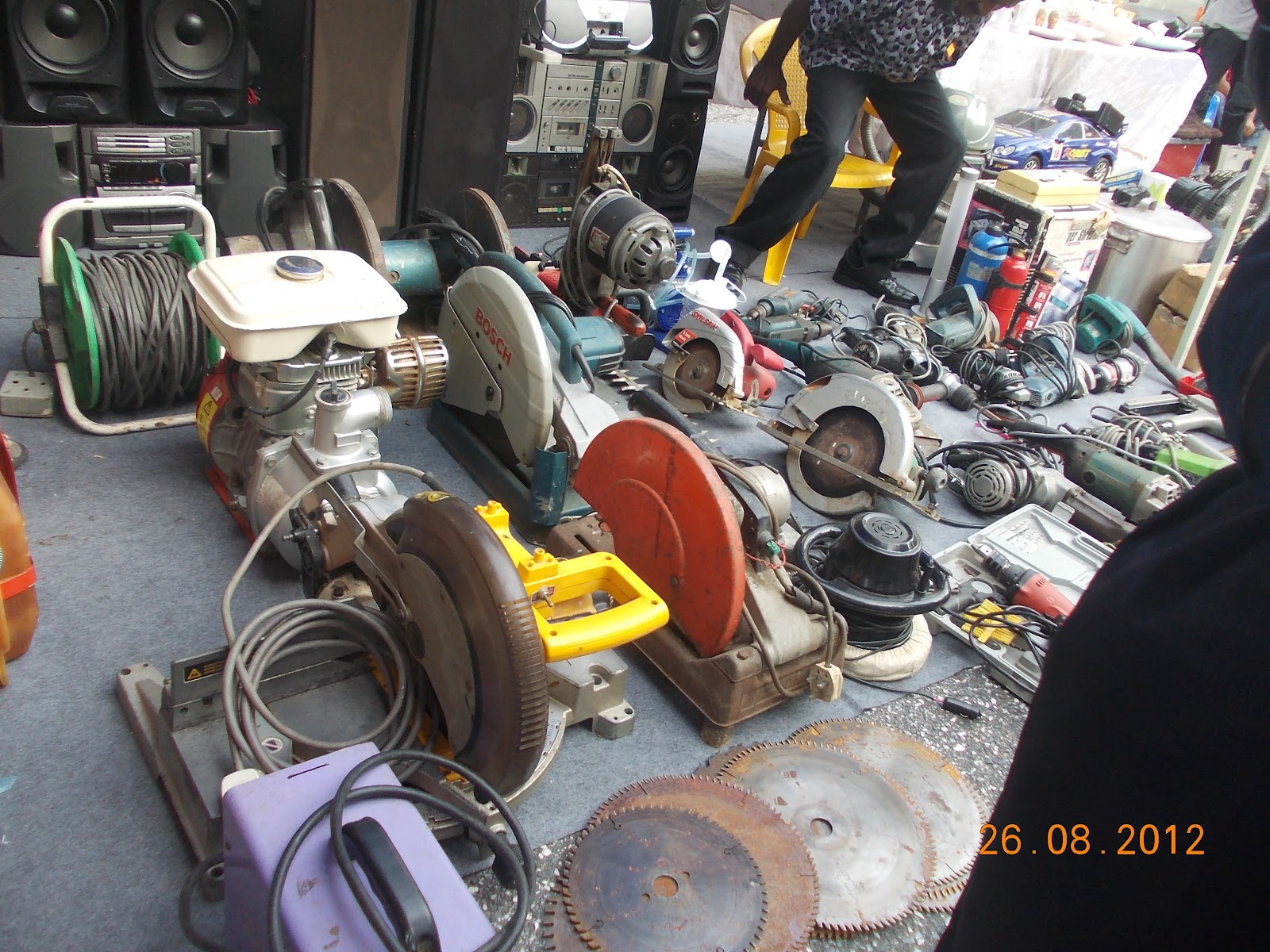
This guy here sells a mixture of new and old hardware.  Electric cutter, circular saw, polisher, they are all there.  If one cannot afford a new one, there is always a second-hand one available. 

This young couple is attracted to a stall selling copper-ware.  Again, there are new and old items for sale.  Of course, most people would prefer the old to the new because of the antique look. 


This stall even sells old  advertisement posters and boxes from the past.  This one really attracted my attention - a 1960's advertising poster of Gordon's Gin and another one of White Label Whisky. 


 Here, clocks of all sorts from the past - some can still work, others are just for display or could be repaired.
 This small crowd seemed to be interested in second-hand electronic gadgets - handphone, handphone covers, battery, or handphone chargers of all brand and make, and even an outdoor speaker!


       If one is not interested in all the electronic items then how about some old magazines and books?  Old copies of  National Geographic are in great demand- but never short of supply from this man.  Old books and a spotted even a whole volume of law books!


Wednesday, 21 March 2012

Old Cinemas in Ipoh

A friend of mine emailed me some beautiful photographs of old cinemas in Ipoh.  They were taken by a chap named Eddy Foo.  I cannot recall this person on my worn-out memory but I assume that I might have known him.  He certainly takes good pictures, just like a professional.  When I showed these photographs to my other friends, they said that he must be using a camera that would probably cost us an arm or a leg.  I suppose they are right but then, equipment alone do not create good pictures like these.  The photographs are all taken at the right angles and with the best backdrop..  In short, the composition is simply amazing.  They are the product of the photographer more than just the equipment alone.  Here they are and I hope Mr Eddy won't mind me using his photographs on my blog: :   


This is the Odeon Cinema.  I remember it as a cinema located at the end of Brewster Road.  We used to walk to the cinemas those days, so to get there, it was a long walk.  I watched quite a few black and white Malay and English movies at this cinema.  


The Lido Cinema was a more popular cinema and it screened movies from the Shaw Brothers' stable.  At that time, there was a monthly movie magazine - Movie News - that gave preview and review of  movies that will be shown in Show Brother's cinemas.  I think I watched Ben Hur here! 


Opposite Lido Cinema, was the Cathay cinema.  This was the the main rival of the Shaw Brother's chain of cinemas.  Cathay cinema was just as popular and it screened mostly English movies.  What's more interesting is that both the Lido and Cathay cinemas have morning shows -10.30 am - on every weekends which were called Cheap Matinee - because the ticket cost only 50 cents and the shows were second-run movies. Usually popular old cowboy movies and Tarzan movies were screened during this time.     


The Ruby cinema was just on the next street, Cowan Street.  I seldom went there to see a show because it screened mostly Hindi and Tamil movies.  But, later on it showed Chinese movies too.  I watched the "One-armed Swordsman" there.


Rex cinema was the other popular Shaw Brothers cinema in town.  This one showed mostly Chinese movies from Shaw Brothers' production.  Movies starring David Chiang and Fu Shang were the craze during my time as a teenager.  One has to actually go early to make advanced booking for the day for otherwise the tickets would be sold out and then there will be touts selling tickets at black market prices before each show.

Monday, 12 March 2012

Taiping Wet Market

It has been said that the growth of most towns is focused around its market.  This is true of Taiping town, where the main wet market is located the centre of the town.  Actually, the market is divided into two sections.  The two sections are separated by Jalan Kota.  The older section was built in 1884 and it stretches from Jalan Taming Sari (Main Road) to Jalan Kota, while the newer section of the market was built in 1885 and it stretched from Jalan Kota to Jalan Panggung Wayang.  The Wet Market has a north-south orientation.  The structure of the market was constructed in such a way that it harnesses the morning breeze that blows down from the Larut Hills and the evening breeze from the Matang / Kuala Sepetang coast.  Being designed in such a manner, it is very well ventilated and the inside is always cool throughout the day.

     
This is a scaled-down cross-sectional model of the Wet Market constructed by Teoh Chee Keong's students from UCSI. The wet market was  built in 1884.  The original market measures 220 feet by 60 feet.  As can been seen here, the sides and front of the market are opened, without walls to allow are to flow in and out.  Hot air will rise up the high roof and escape through the louvres.  This is a very efficient way of cooling the place.


        The older section of the wet market as it is today.   Fresh fish, vegetables and fruits are sold in this section of the wet market

The mutton, beef and chicken market.

                                    
Another view of the newer section of the market (the one with the brown roof) where mutton, beef and chickens are sold.

A picture of the ceiling of the wet market.  It can be seen clearly that the windows at the top allow light into the market and the louvres allow hot air to escape that ventilation system is ideal for a tropical town market like this one.


Teoh Chee Keong from UCSI (in red T-shirt) together with a local reseacher, Lee Eng Kew, conducted a Taiping Heritage Trail on 11 March 2012 with a visit to the market where he explained the finer details of the unique design of the building and thus must be preserved as it is an invaluable heritage to the people of Taiping.   Listening attentively was a crowd of concerned citizens.  

 Another cross-sectional model of the market. This is the model of the section which sells pork.  This section was built later and was attached to back of the old market.


The marble-top tables at the pork market looked clean and tidy even though the market is more than a hundred years old.  As a matter of fact, the marble tops were imported from Italy and still look as new as ever.   It was a Sunday, and so the stalls were empty.

In his talk on "People of the Market" - Teoh Chee Keong introduced Loo Peng Wah, a third generation pork seller at the market and allowed him to tell his own story.

Model of "Siang-Malam"


The section of the market which is known as the "Siang-Malam".


This is the model of the section which is attached to the mutton, beef and chicken section.  It faces Jalan Kota and is more popularly known as "siang-malam" meaning "day and night."  There will be activities there day and night.  By day there are roast pork stalls and stalls selling mee and curry power.  By night, it's hawker food stalls.  This is also the place where the infamous 'rain betting' was once carried out.   


When the wet market was finally ready and functioning, shop houses, like this one above, began to sprout up around it.  The market has always been the centre of activities and is indeed a catalyst to the growth of the town.  It is an important centre for social and cultural interaction.  Any attempt to relocate the  wet market to the outskirt would not be wise for it will make Taiping not only lose one of its most important heritage buildings but also lose its very character and identity.