Sunday, 6 November 2011

Brastagi to Lake Toba

The journey continued through the beautiful countryside from Brastagi to Lake Toba. It took about four hours by bus and we moved from Batak Simalungun territory to Batak Toba region.  The people there grew beautiful flowers, fruit trees and vegetable on the fertile volcanic soil.  The dark volcanic soil can be seen all over the area.  


This is the district governor's office and it is built according to the traditional Batak architectural style. 


Nearby, there is this big mosque, as there is a large number of Muslims in this area. 


Not to far away, is this Hurai Batak Protestant church, which is also built according to traditional Batak style.


As the bus stopped at a Pertamina Petrol Station to for a gas refill, the view of the active volcano, 
Mt. Sinabung, at the background, is just magnificent.


A van-bus filled with passengers too pulled up for gas.  This is the only petrol station between Brastagi and Lake Toba, so most vehicles traveling along this road stop for a refill.   


All around, is agricultural land, and with the rich volcanic soil, almost anything grows well here.  


This is the family cemetery.  Each farming family will allocate a small area for burial of family members.  Of course, the great grand ancestor who first worked on the land is given a grand memorial / grave such as this one.  The whole countryside here is dotted with family graves, from farm to farm. 


The favourite food of the Batak here - Babi Panggang Karo.  In every village, there will be stalls with the sign BPK - selling roast pigs. 


Finally, after four hours the bus arrived at Parapat, a town at the edge of Lake Toba.  This is the famous Sipiso-piso waterfalls, located at the fringe of Lake Toba. 


A school near Parapat.

 
This is Permatang Purba, the village of the royal palaces of the King of Batak Simalungun.


This is one of the reconstructed royal houses at the village.


Tourists going from house to house to inspect the royal palaces. 


This is the largest palace, and it is said that this was the house of the 24 wives of the King!


Lake Toba is finally visible, and its vastness is simply mind-blogging!  It is said to be about a few times the size of Singapore island! 


Lake Toba seen from another place


Lake Toba, seen with its islands in the centre.   


The weather was just nice that day for getting a good picture of the lake.

Thursday, 3 November 2011

From Medan to Brastagi


It was an interesting journey on a bus from Medan to Brastagi which went through some scenic countryside and hilly Batak country.  It gave me a chance to look at the simple life of the people in that area.  There are quite a number of large, high rise, modern buildings in Medan but it was the simple, rustic and unchanged lifestyle of the people there that caught my attention.  While much of Medan city itself has undergone changes, there are still a lot by the wayside that has remained the same since the last half century or so.


The Polonia airport at Medan is the main entry point to North Sumatera


Medan, like most Southeas Asian cities, is riddled with traffic jams. Public vehicles like this van-taxi is one of the most popular means of transportation around town.  However, we have been told that it is best for foreign visitors to try getting only on the yellow ones or the blue ones because their charges are more reasonable.     

Another mode of public transport is this motorised trishaw.  They are seen almost everywhere in town.  Some are modified to look more attractive while others make do with just a cover from a discarded advertisement poster. 


Foreign visitors again has been advised not to use this popular local mode of transport because they can charge totally unexpected rates.  Always bargain - if you can speak their language - before getting on one.  In Medan, a 70 -100cc Japanese motorcycle is attached to the carriage but in  the nearby town of Siantar, the ancient Triumph, Harley Davidson and  Norton motorbikes are used.

Right in the middle of Medan is this monument of Justice.  It is located within the compound of the Rahmat International Wildlife Museum.   


The signboard of Rahmat International Wildlife Museum where visitors can view stuffed animals.


Also located within the compound of the Rahmat Museum, is the office of the Indonesian Red Cross Society. 


A closer look at the motorised trishaw.


Amidst the busy traffic, a bread vendor is plying his trade. 


At another part of town, artists too make a living by selling giant custom-made wedding cards which are very popular.  These are displayed at weddings, anniversaries, birthdays, and even funerals.


At junctions where there are traffic lights, there will be young boys and girls selling all sorts of things from newspapers, flowers and even providing entertainment - like this boy and his friends, they will sing songs for a few rupiahs.


They are performing when the traffic lights turned red and motorists are entertained by them, then a few kind souls will toss a few rupiahs to these young singers. 


In smaller towns outside Medan, the trishaws rules the roads.  Here in this town, there are special parking bays for such trishaws. 


Along with the trishaws are mobile stalls selling food.  food is one of the popular ways to earn a living here.


Somewhere in the countryside, is this interesting stall selling tuak or local palm wine.  The fresh one is quite nice to drink - sweet and does not have the strong smell like our local toddy.  


A few blocks away is this place selling BPK or babi panggang karo - Karo roast pigs.  No, I did not try any of this, following the advice of my guide.   


As we traveled across Batak country, we noticed there are so many churches built across the countryside.  Every village has its huge church of the HKBP or Huria Kristen Batak Protesten.    


Apart from HKBP churches, there are also some isolated buddhist temple too.  At Lumbini, there is this beautiful golden buddhist pagoda.


Finally, we arrived at Brastagi.  It is a hill resort type of town.  The main attraction in the town is the fruit market.  


This is the location of the fruit market, which also sells flowers and clothing.


The fruit market at Brastagi

Sunday, 11 September 2011

Mid-Autumn Festival in Taiping

The Mid-Autumn Festival which is more commonly known as the Mooncake Festival in Malaysia, or the Lantern Festival in Singapore, is one of the few important Chinese festivals celebrated on a large scale in this country.  However, in this small town of Taiping, the Mid-Autumn festival is celebrated on a moderate scale this year.  There is no processions as was done a few years ago but still individual Chinese clan associations carry on the tradition of providing the local community with some element of festivities.  
Mooncakes of all tastes and shapes are promoted at all departmental stores and the prices of the "branded" ones reach the moon.  For cheaper, but not necessarily less tasty ones, try the wet markets and night markets.
Thus, it is from this delicacy that the Malaysian gave the festival the name "Mooncake Festival".  The arrogant Singaporeans chose not to have the festival related to the word "moon" because they argue that man has already stepped on the moon and so to have a moon festival would render themseves mentally backward. Hence, they changed the name to Lantern Festival.   Classical kiasu mentality, I would say.  As Shakespeare said : Giving a rose any other name, will make it just as sweet.
Now, in Taiping we have the Kwantung Association which has never failed to bring in a Chinese Opera troupe to perform for a week each year, to celebrate this festival.   This year was no different, so here are some pictures of the performance:


 A gathering of generals backstage

              The white-faced character in Chinese opera is usually given the role of a clown or small soldier

 The generals are those with flags on their backs


A short video clip of the performance


            The opera was sponsored by generous donors and their names were displayed on these flyers. 


It is sad to note that such cultural performances do not attract the younger people and this is why some Chinese associations would rather choose to stage modern pop concerts than traditional operas.  The loss of interest in traditional arts is quite universal and something needs to be done to rekindle interest in them amongst the younger generation or else another living heritage will face extinction.

AT THE LAKE GARDENS

In the meantime, while the opera goes on, at the nearby lake gardens, lots of people gather to light up lanterns and candles.  In the past, when most people lived in villages with areas where children can go around playing with lanterns, such luxury is now gone.  The roads are simply too dangerous for children to walk in groups with lanterns.  As a result, the lake gardens provide an ideal venue.

            This lady came early with her family and prepared home-made colourful paper lamps  
                     Here's what her lamps looked like after she has lighted them up with candles.
 The younger people let off fireworks, not those expensive ones, but good enough to keep everyone happy
.
People just find a place to sit on the ground while the children lighted up the place with lanterns.

 Children find it fun to see and mix around with so many other people and each family or group tries to be     as creative as possible with their arrangement of lanterns and candles.

                      Some hang their lanterns on trees while others put more effort on the ground.


All in all, the lake gardens was quite a beautiful sight to behold but then, if only there are more responsible people who will also remove whatever rubbish they have before they leave the place, it would be better.  Hopefully, with all the hypes about the environment, the younger generation will not just give lip service to such ideas but put them into practice too.


Tuesday, 12 July 2011

The Rainforest World Music Festival 2011

The Rainforest World Music Festival 2011 was held at the Sarawak Cultural Village, Santubong from the 8 - 10 July 2011.  This annual three-day event has never failed to draw large crowd of foreigners as well as locals.  this year, the newspapers estimated a crowd of around 20 thousand people for the first night and 25 thousand for the second and the third nights.   Most of them are repeated visitors, which means they come back year after year. Why and what's so special about this festival?  So, this year, I make it a point to get there to see it for myself.
The music and songs played offer alternatives to the mainstream music heard on radio and television.  No lady gaga lookalikes, just good musician playing good tunes and singing in their own native language.  Most people don't understand the lyrics of the songs but the beat of the music is universal, and it comes straight from the hearts of performers.  There is a strong bond between the performers and the crowd below the stage.  There is interaction and total physical response between the two which is seldom found in modern day pop concerts.  I have a few clips here and hopefully you can see what I mean.  However, please bear in mind that these clips were taken using a cheap, low-specs, point and shoot digital camera - so the quality may not be very good.

ISKWEW FROM CANADA


This short video clip is from the performance of the Iskwew from Canada.  They are from one of the native tribes there.  Their songs was about the universe and brotherhood - all sang in their own language - and in the middle of their singing, they came down from the stage and asked everyone to join hands in a circle and move in a clockwise direction according to the beat of the song.  Gradually, more and more people joined in, and just imagine thousands of people held hands in a giant circle that moved to the beat of the universe!  That's how powerful these performances are!!

LEWETON WOMEN'S WATER MUSIC FROM VANUATU


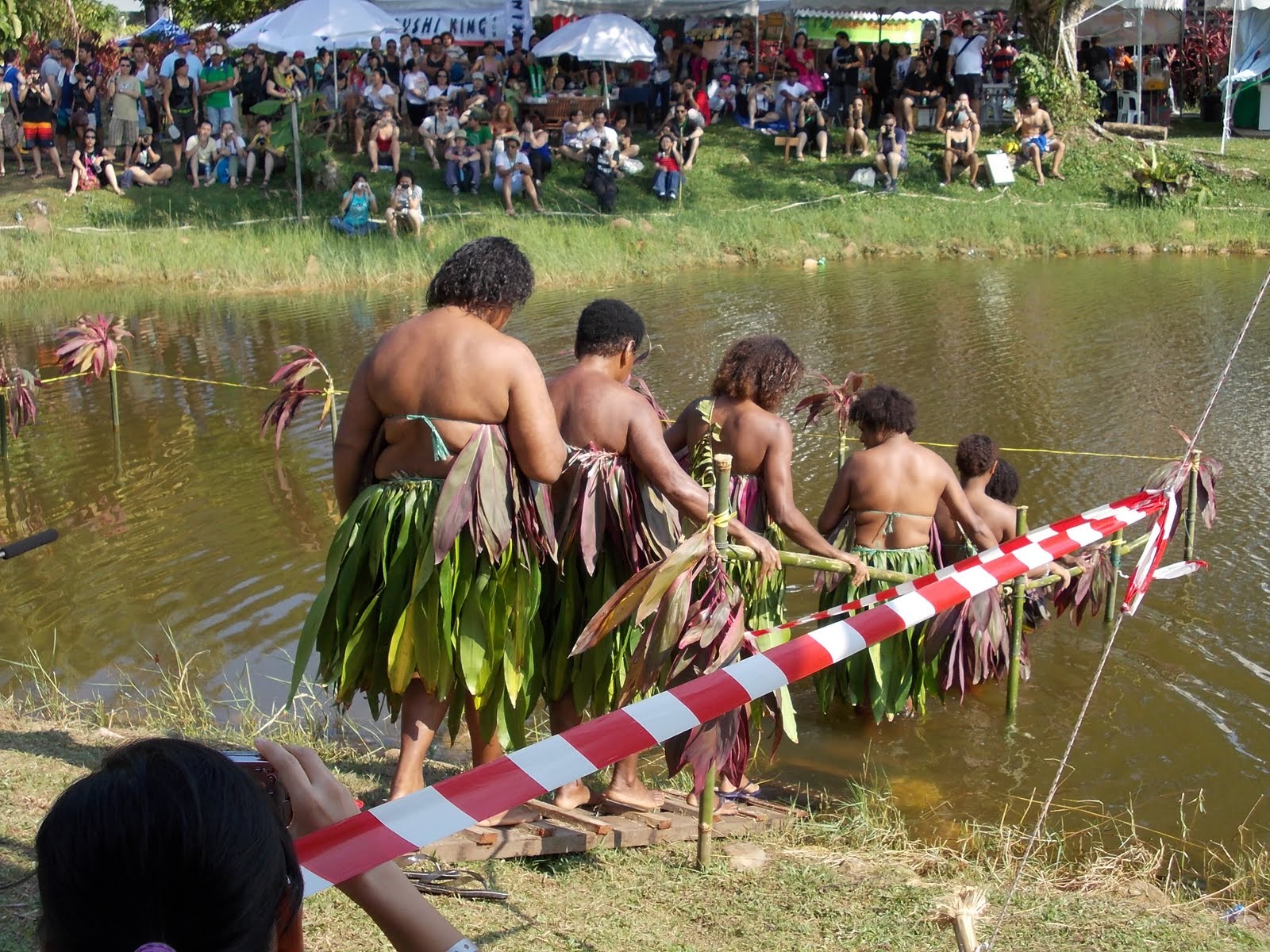
This is a unique performance by six very pretty women from Vanautu.   The performance was done in the afternoon with them singing an introductory song on the bank of the lake - as seen in the video clip above. Since they wore nothing except for some leaves, it would not be too safe to perform at night with all those infamous Sarawak Woman-Eating crocodiles lurking around the lake That aside, they gradually went into the lake and started their music by beating the water with their hands.  The unison of the beat create a base for them to sing their song.  It is truly a natural form of rainforest music.  

HERE ARE SOME STILL SHOTS OF THEM GOING INTO THE LAKE AND BEATING THE WATER WITH THEIR BARE HANDS TO CREATE MUSIC 


AN ACCORDION WORKSHOP AND JAM SESSION  

Liza Haley, from the USA, showing the audience her skills on the accordion 


There were also workshops on the different musical instruments held in the afternoon and I attended the one on accordion.  Here, five different accordion players from five different countries and who speak five different languages came together to share a common ground - playing the accordion.  Each of them tried to explain to the audience about themselves and their accordion and then suddenly before the session ends Jaoquin Diaz from the Dominican Republic stood up and suggested that they have a jam session - all agreed.  He started playing a popular tune and then one by one jammed in with his/her own unique style - the result - fantastic music from them, done without practice.  Here's the part of the jam session in the clip below: 

             
VICTOR VALDEZ TRIO

This trio comes from Mexico and the audience simply loves them.  They play beautiful Mexican folk songs to a contemporary beat, keeping the audience on their feet.  Again, they have a good rapport with the audience. When a group asked for a special song which was quite popular, they agreed to play it for them even though they never rehearsed that one before.  The result? - just look at the clip below:


The Rainforest World Music Festival is all about connection - positive connection between performers and audience.  The performers did better and better when the audience responded positively.  The audience's response energise the performers and in return their performances turn the audience on.  This year 21 groups from different parts of the world performed together to give the occasion a feel of a good music festival, however, there will be some groups which will not be as appealing to the crowd as others.        
In this festival, the audience is a participating one and not a passive one which stays seated in their places.
So, if you plan to go to next year's festival, be sure to be a participating audience or you will not enjoy the whole thing to the fullest. Do not go with certain expectations for you will surely be disappointed if your expectations are not met.