Sunday, 11 September 2011

Mid-Autumn Festival in Taiping

The Mid-Autumn Festival which is more commonly known as the Mooncake Festival in Malaysia, or the Lantern Festival in Singapore, is one of the few important Chinese festivals celebrated on a large scale in this country.  However, in this small town of Taiping, the Mid-Autumn festival is celebrated on a moderate scale this year.  There is no processions as was done a few years ago but still individual Chinese clan associations carry on the tradition of providing the local community with some element of festivities.  
Mooncakes of all tastes and shapes are promoted at all departmental stores and the prices of the "branded" ones reach the moon.  For cheaper, but not necessarily less tasty ones, try the wet markets and night markets.
Thus, it is from this delicacy that the Malaysian gave the festival the name "Mooncake Festival".  The arrogant Singaporeans chose not to have the festival related to the word "moon" because they argue that man has already stepped on the moon and so to have a moon festival would render themseves mentally backward. Hence, they changed the name to Lantern Festival.   Classical kiasu mentality, I would say.  As Shakespeare said : Giving a rose any other name, will make it just as sweet.
Now, in Taiping we have the Kwantung Association which has never failed to bring in a Chinese Opera troupe to perform for a week each year, to celebrate this festival.   This year was no different, so here are some pictures of the performance:


 A gathering of generals backstage

              The white-faced character in Chinese opera is usually given the role of a clown or small soldier

 The generals are those with flags on their backs


A short video clip of the performance


            The opera was sponsored by generous donors and their names were displayed on these flyers. 


It is sad to note that such cultural performances do not attract the younger people and this is why some Chinese associations would rather choose to stage modern pop concerts than traditional operas.  The loss of interest in traditional arts is quite universal and something needs to be done to rekindle interest in them amongst the younger generation or else another living heritage will face extinction.

AT THE LAKE GARDENS

In the meantime, while the opera goes on, at the nearby lake gardens, lots of people gather to light up lanterns and candles.  In the past, when most people lived in villages with areas where children can go around playing with lanterns, such luxury is now gone.  The roads are simply too dangerous for children to walk in groups with lanterns.  As a result, the lake gardens provide an ideal venue.

            This lady came early with her family and prepared home-made colourful paper lamps  
                     Here's what her lamps looked like after she has lighted them up with candles.
 The younger people let off fireworks, not those expensive ones, but good enough to keep everyone happy
.
People just find a place to sit on the ground while the children lighted up the place with lanterns.

 Children find it fun to see and mix around with so many other people and each family or group tries to be     as creative as possible with their arrangement of lanterns and candles.

                      Some hang their lanterns on trees while others put more effort on the ground.


All in all, the lake gardens was quite a beautiful sight to behold but then, if only there are more responsible people who will also remove whatever rubbish they have before they leave the place, it would be better.  Hopefully, with all the hypes about the environment, the younger generation will not just give lip service to such ideas but put them into practice too.



Tuesday, 12 July 2011

The Rainforest World Music Festival 2011

The Rainforest World Music Festival 2011 was held at the Sarawak Cultural Village, Santubong from the 8 - 10 July 2011.  This annual three-day event has never failed to draw large crowd of foreigners as well as locals.  this year, the newspapers estimated a crowd of around 20 thousand people for the first night and 25 thousand for the second and the third nights.   Most of them are repeated visitors, which means they come back year after year. Why and what's so special about this festival?  So, this year, I make it a point to get there to see it for myself.
The music and songs played offer alternatives to the mainstream music heard on radio and television.  No lady gaga lookalikes, just good musician playing good tunes and singing in their own native language.  Most people don't understand the lyrics of the songs but the beat of the music is universal, and it comes straight from the hearts of performers.  There is a strong bond between the performers and the crowd below the stage.  There is interaction and total physical response between the two which is seldom found in modern day pop concerts.  I have a few clips here and hopefully you can see what I mean.  However, please bear in mind that these clips were taken using a cheap, low-specs, point and shoot digital camera - so the quality may not be very good.

ISKWEW FROM CANADA


This short video clip is from the performance of the Iskwew from Canada.  They are from one of the native tribes there.  Their songs was about the universe and brotherhood - all sang in their own language - and in the middle of their singing, they came down from the stage and asked everyone to join hands in a circle and move in a clockwise direction according to the beat of the song.  Gradually, more and more people joined in, and just imagine thousands of people held hands in a giant circle that moved to the beat of the universe!  That's how powerful these performances are!!

LEWETON WOMEN'S WATER MUSIC FROM VANUATU


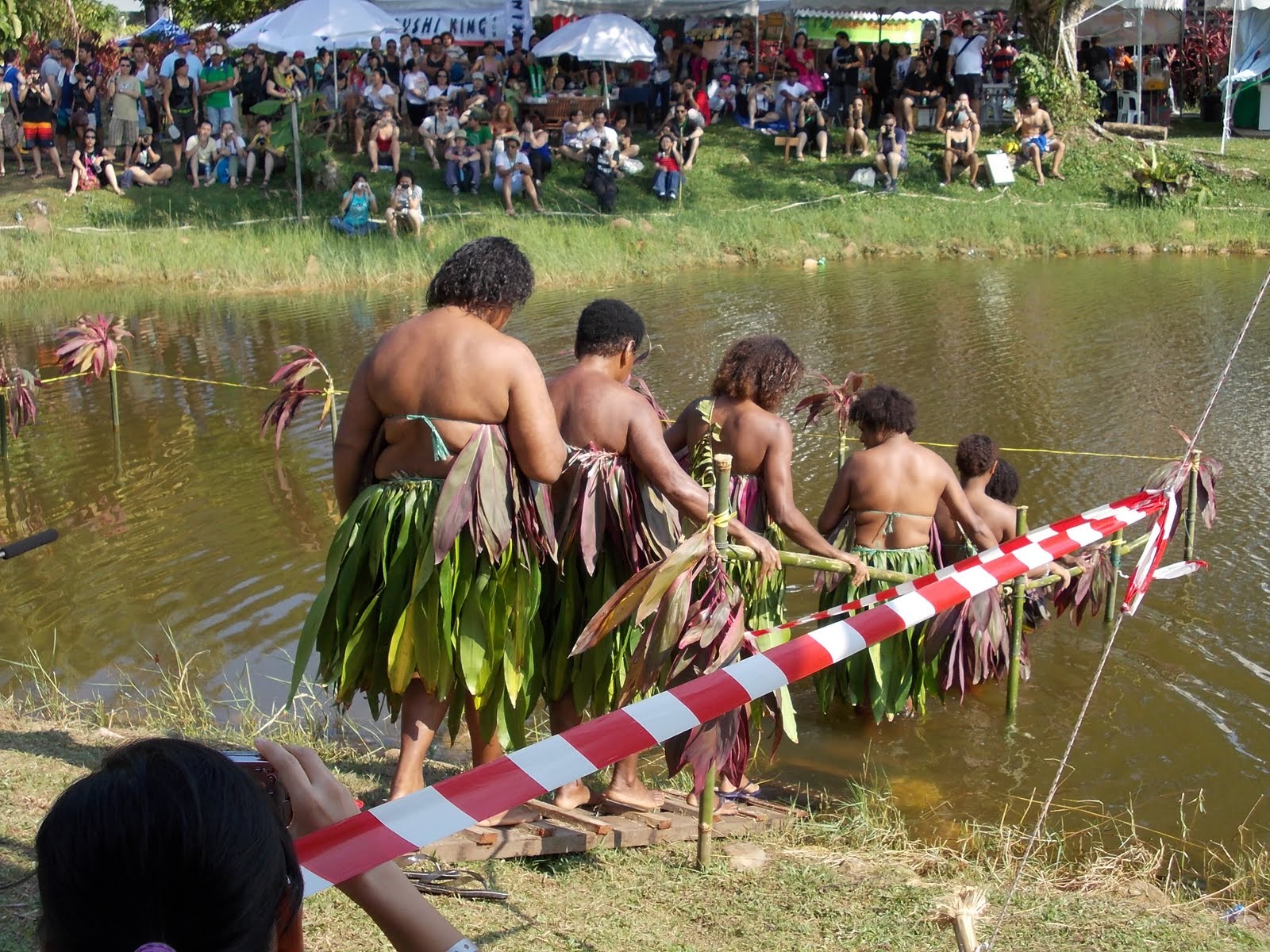
This is a unique performance by six very pretty women from Vanautu.   The performance was done in the afternoon with them singing an introductory song on the bank of the lake - as seen in the video clip above. Since they wore nothing except for some leaves, it would not be too safe to perform at night with all those infamous Sarawak Woman-Eating crocodiles lurking around the lake That aside, they gradually went into the lake and started their music by beating the water with their hands.  The unison of the beat create a base for them to sing their song.  It is truly a natural form of rainforest music.  

HERE ARE SOME STILL SHOTS OF THEM GOING INTO THE LAKE AND BEATING THE WATER WITH THEIR BARE HANDS TO CREATE MUSIC 


AN ACCORDION WORKSHOP AND JAM SESSION  

Liza Haley, from the USA, showing the audience her skills on the accordion 


There were also workshops on the different musical instruments held in the afternoon and I attended the one on accordion.  Here, five different accordion players from five different countries and who speak five different languages came together to share a common ground - playing the accordion.  Each of them tried to explain to the audience about themselves and their accordion and then suddenly before the session ends Jaoquin Diaz from the Dominican Republic stood up and suggested that they have a jam session - all agreed.  He started playing a popular tune and then one by one jammed in with his/her own unique style - the result - fantastic music from them, done without practice.  Here's the part of the jam session in the clip below: 

             
VICTOR VALDEZ TRIO

This trio comes from Mexico and the audience simply loves them.  They play beautiful Mexican folk songs to a contemporary beat, keeping the audience on their feet.  Again, they have a good rapport with the audience. When a group asked for a special song which was quite popular, they agreed to play it for them even though they never rehearsed that one before.  The result? - just look at the clip below:


The Rainforest World Music Festival is all about connection - positive connection between performers and audience.  The performers did better and better when the audience responded positively.  The audience's response energise the performers and in return their performances turn the audience on.  This year 21 groups from different parts of the world performed together to give the occasion a feel of a good music festival, however, there will be some groups which will not be as appealing to the crowd as others.        
In this festival, the audience is a participating one and not a passive one which stays seated in their places.
So, if you plan to go to next year's festival, be sure to be a participating audience or you will not enjoy the whole thing to the fullest. Do not go with certain expectations for you will surely be disappointed if your expectations are not met.   


Tuesday, 28 June 2011

The New Club Taiping

The New Club Taiping is actually an old club, it is in fact the oldest club in South East Asia.  The origin of the club can be traced back to the British Administration period in history where planters needed a place to meet and socialise.  The history of The New Club can easily be found in many other blogs and thus there is no need for me to re-mention it here.  What interests me is the fact that much of the "colonial" aspects of the physical club house still remained intact and functioning.    From the roof right down to the toilet, traces of its colonial past are still there.


This official board was erected by the town council to give a brief history of the New Club which was said to be established in 1894.


 This is the old wooden building where the present day administration office, library and guest chambers are located.  Built in colonial style on concrete pillars, not much of the design has changed.


The walls and windows still retained its original shape and design.  And even the awning for each of the windows are so well restored.  I have not seen a better preserved wooden awning like this one anywhere else in town.

Although there has been a bit of adaptation done to enable air-conditioning, the windows still have the old-fashioned awnings which add character to the building. 


This is inside the man's toilet.  No where else in town has the colonial day urinal been better preserved and is still in service.   Even the ventilation windows are from the original toilet.   


     These urinals look so solid and can still last for a few more centuries if they are properly managed. 


On closer inspection, one could still see the trademark of the manufacturer on each of the urinals - it was manufactured by Doulton Co. London.   The toilet itself is not the old one, this is a new toilet but the contractor has been told to retain and reuse as much of whatever that can be used in the process of renovation from the old toilet.  Cultural conservationists should take a leaf from this - if we cannot save everything - at least save as much as possible.       


Then we have the conference room.  This is again a heritage building made of wood.  The interesting aspect of this building is that it is build on steel stilts.  It must have come across the mind of the designer that to avoid the perils of destruction by termites and the tropical weather, steel could be used to overcome this problem.  


Today the building still stand on the strong steel stilts and the interior of the building has been modified to accommodate air-conditioning, but the doors, windows and the exterior design have been retained.  The New Club may seem to be just an insignificant small building in a fast developing town, but there is much to be learnt about restoration of old buildings without causing much destruction to their original forms and character.    


Monday, 27 June 2011

The Taiping Dobi Line

There is this area near the Taiping Lake Gardens where the old-fashioned laundry service is still available and it is more commonly known as the dobi line.  There is a flat and the laundry shops are all located on the ground floor.


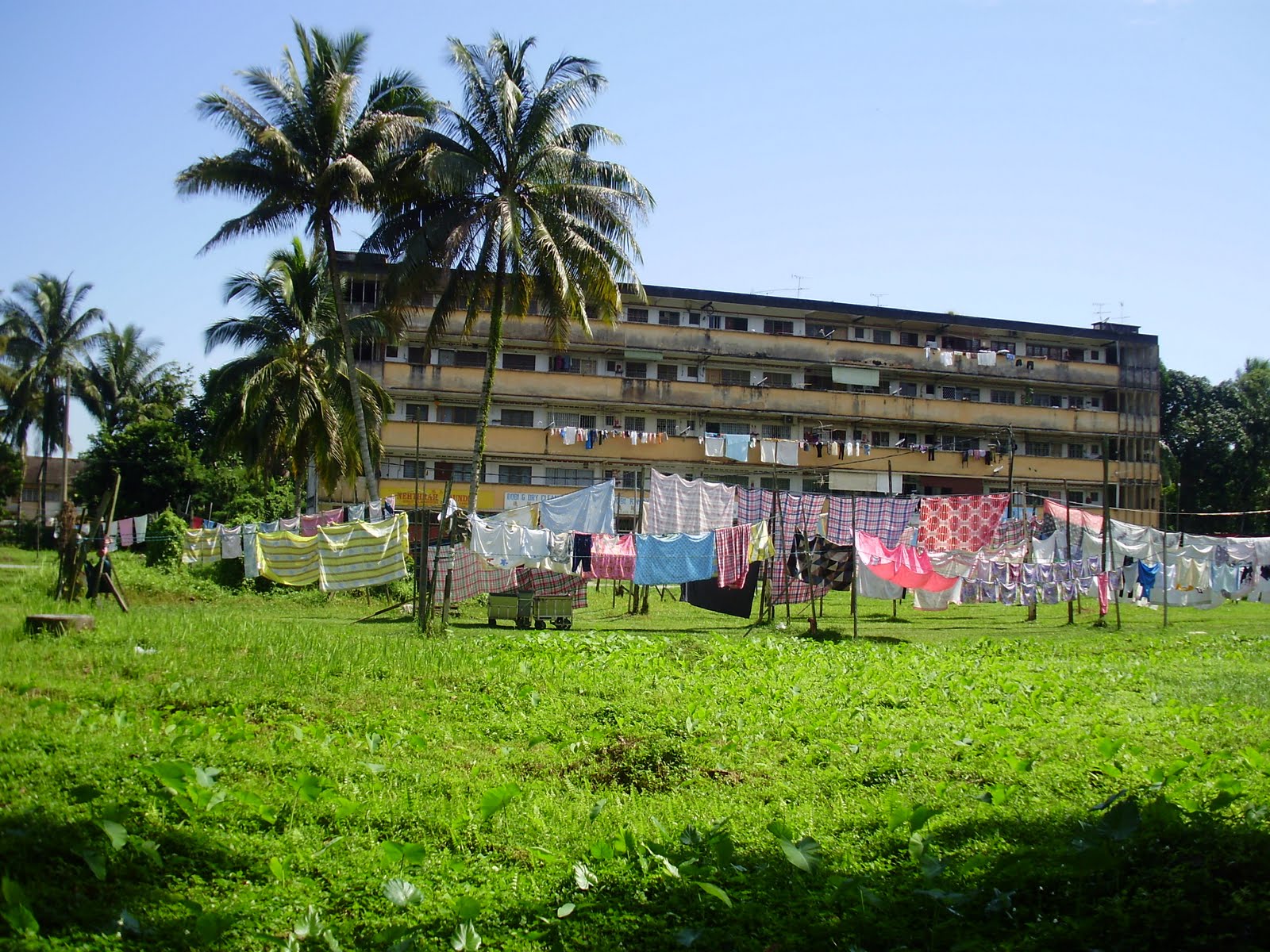
There is an open space in front of the flat and this is where the washed laundry is being dried in the sun.


What is interesting about this service is the way they hang the items out to dry.  Ropes are used for this and the pieces of clothes or cloth are gripped by two pieces of twisted ropes.  No pegs are used at all.  


The laundry shops lined up the ground floor and there is a good mixture of Indian and Chinese doing this business.  They still do it the way their fathers and grandfathers did it, many decades ago. 


Once the cloth and clothes are ready, the ropes are raised above the ground by supporting poles.


Here we can see an old man pushing a cart full of wet laundry and getting them on the ropes to be dried.


Morning is a time when we can see them coming out to dry the laundry, most of which are washed by hand.


Most of the items come from restaurants and small hotels around the town, but they still get a lot of business from loyal individual clients too.


Then as evening approaches, it is time to collect the dried items back before night fall.   Usually on a hot day like this and with the wind constantly blowing across the open space, the laundry will be dried in the afternoon.. 


At present, this place is facing competition from modern laundry shops in town which use washing machines to do the job.  The main problem, however, is not one of changing the mode of operation, but one of the lack of man-power.  The younger generation no longer wants to continue doing this kind of thing, even though they are never short of clients.  Only time can tell if this particular institution of our society will remain or will it disappear in a few generations' time.   Washing machines are certainly not as pretty looking as the scenery we have here and now. 

Wednesday, 11 May 2011

The historical Lenggong region

Today, the road from Kuala Kangsar to Gerik is a modern 4-lane highway.  This has delighted a lot of frequent travellers along that part of the country.  However, the highway has by-passed several towns and villages which were once important ports of call from the weary travellers. But, somehow, these towns have survived and some people still stop at towns like Ayer Kala, Lenggong and Sauk for their breakfast, lunch or dinner before continuing their journey.  Although these towns are off the highway, people are still willing to turn into the old road to these place to taste their famous freshwater delicacies.


At the main road in Lenggong town is this famous restaurant which sells the famous Lenggong fish-balls.  These fish-balls are made from fish caught from the nearby river and lakes and are more springy or bouncy than those sold at other places.    


On the main road too, is the Lenggong post office.  It is still located in the same old building which was built years ago.  In most other places, post office like this would have been replaced by some ugly modern one.  This post office has a character of its own.


Not too far from the Post Office are two more restaurants which sell the famous Lenggong fish-balls and also a whole variety of fresh water fish dishes.  On certain days, even fresh water frogs are available.  It must be said that all three restaurants are good but each has its own style of preparing the dishes.  So it is up to the individual to give the verdict as to which is actually the "best".  Whatever fish you order, please remember to ask about the price first because some variety of fresh water fish can be quite expensive.

THE LENGGONG MUSEUM OF ARCHEOLOGY


This signpost is placed at the junction of the main road and the smaller road leading to the museum.  It is just a few kilometers from Lenggong town.


The entrance to the museum is rather unique and is made to look like cave.  Admission the museum is free.


The museum is proud to house the story of how the remains of the Perak Man was found and the discovery of the existence of a very early civilization.  There are a lot of displays like the ones above and also ancient artifacts from archeological work done in the area. 


This is a urinal pot  - for people of the olden times who are just too lazy to go to the toilet at night.  It is part of the exhibits displayed at the maritime exhibition section. 


The museum has outdoor exhibits too.  Here rocks and their characteristics and time of their formation are being displayed.  It will give the geography teachers great happiness to bring their students here for a better understanding of rock formation.

LATA KEKABU


Nearby is a popular picnic spot by a beautiful waterfall - named Lata Kekabu.  On weekends, the crowd will be there.  This place is well kept and the surrounding is peaceful.  However the road leading to this waterfall is quite narrow and one should drive slowly and carefully.


This is the entrance to the waterfall and there is ample parking space for cars. This place is very spacious and there is a lot of room for people to sit under the shade of trees.  There are changing rooms too so one need not hide behind bushes to change clothes.    


As we enter the place, we can see a wooden foot bridge across the steam of clean and clear water.  There will be a signboard after the bridge to show directions.  Just follow the directions and you will come to a "hanging bridge" where you can go on to see the waterfall.  Do be careful because some of the other bridges further up are not in very good condition and are in need of repair. 

TASIK RABAN RESORT

On the way back to Kuala Kangsar, we stopped at the Tasik Raban Resort.  This place is located at the lake side and has numerous chalets for rent.  It is a haven for anglers because the lake is full of freshwater fish.


Here we see a row of chalets which are suitable for small families and they all provide a good view of the lake.  The rental rates are reasonable too.   It is managed by the Lenggong District Council which can be contacted through 05-7512799 or through its website - www.mdlg.gov.my


This is the resort restaurant and it is located on the opposite side of the lake.  It serves some good freshwater dishes and will also cook fish caught by its guests.


To move around the area, one could rent these bicycles.  It will provide you with good exercise because the air at the countryside is fresh and clean.  It also gives you a chance to have a closer look at the countryside, which you may not be able to do if you were to drive a car.    

  This is the gateway to welcome you to Tasik Raban Resort, in Lenggong.  If you plan to have a quite and relaxing holiday, then give this place a try.

KAMPUNG BARU SAUK

For lunch, we stopped at Kampung Baru Sauk, a few kilometers away from Lenggong towards Kuala Kangsar.  This small village is famous for its river fish dishes. On weekdays, at lunch time, this place looks rather quiet but at night, especially on weekends, the place is so crowded that one may have to wait for some time to get an empty table.


                                                This is the gateway leading to Kg. Baru Sauk.

 There is a lonely barber shop across the road -it looks airy and even has a bench outside for customers to sit and wait for their turn.  Surely this is a good sign that this barber enjoys good business from the villagers.  

                                       Another view of the arch that leads to Kampung Baru Sauk.

  Just beside the gateway or the arch,on the right, is the famous river fish restaurant, you just can't miss it.   It is opened for lunch and dinner.  There will definitely be a large crowd of people on public holidays.